

Every child in Malawi has the right to go to school, see a doctor and grow up safe from harm. For children with disabilities in Malawi, that promise is often broken. Laws exist to protect them, but daily life tells a harder story: closed school doors, thin health services and little say in decisions about their own lives.
At the Child Rights Information and Documentation Centre (CRIDOC), we collect and share child rights information so that people can act on facts, not guesswork. This article looks at children with disabilities in Malawi today. It covers the laws that protect them, the size of the gap between law and life, real case studies, and the opportunities now open to close that gap.
Why children with disabilities in Malawi need more attention
Malawi’s 2018 census found that 5.6% of children aged 5 to 17 live with a disability, up from 2.4% a decade earlier, according to UNICEF Malawi’s Disability Budget Brief. A wider 2019 survey found that 12% of children aged 2 to 17 had some form of functional difficulty. Whichever figure is used, hundreds of thousands of Malawian children live with a disability.
These children carry the same rights as any other child. They also face extra barriers that most children never meet: a school with no ramp, a teacher with no sign language training, a clinic with no wheelchair, a community that still links disability to shame or witchcraft. When these barriers stack up, a child’s right to education, health and protection can quietly disappear.
The legal framework for children with disabilities in Malawi
Malawi has built a real legal base for children with disabilities. The gap lies in how well it reaches daily life.
The Constitution and international treaties
Malawi’s Constitution bans discrimination on several grounds, including disability, and Section 13(g) directs the state to support the “full participation” of persons with disabilities in society, as the UNICEF Malawi Disability Budget Brief notes. Malawi backs this with strong treaty commitments. It ratified the UN Convention on the Rights of the Child in 1991, and the UN Committee that oversees that treaty has said clearly, in General Comment No. 9, that children with disabilities hold the same rights as every other child. Malawi also ratified the African Charter on the Rights and Welfare of the Child in 1999, signed the UN Convention on the Rights of Persons with Disabilities in 2007 and ratified it in 2009, and ratified the regional Protocol to the African Charter on the Rights of Persons with Disabilities in Africa, which entered into force in 2024.
The Persons with Disabilities Act, 2024
Malawi’s main disability law was rewritten in 2024. President Lazarus Chakwera assented to the Persons with Disabilities Act on 2 February 2024, and it commenced that April. The new Act replaces both the 2012 Disability Act and the older 1972 Handicapped Persons Act. It creates the Malawi Council for Disability Affairs (MACODA) in place of the old Malawi Council for the Handicapped, and it sets up a Disability Trust Fund to help pay for disability programmes. The Federation of Disability Organisations in Malawi (FEDOMA) welcomed the law, and said it now names conditions the old law left out, including albinism, epilepsy and psychosocial disabilities. Like its predecessor, the Act sets out rights to education, health care, employment, social protection and accessible buildings, backed by fines and possible prison time for breaches.
A child protection law with no disability lens
Malawi’s main child rights law, the Child Care, Protection and Justice Act of 2010, sets duties on parents and the state, and it runs a separate justice system for children. It does not, however, contain specific provisions for children with disabilities. A deaf child who is abused, or a child with an intellectual disability who cannot describe what happened to them, faces the same general system as any other child, with no extra safeguard built into the law itself. Closing this gap is one of the clearest, most affordable reforms Malawi could make.
Children with disabilities in Malawi, by the numbers
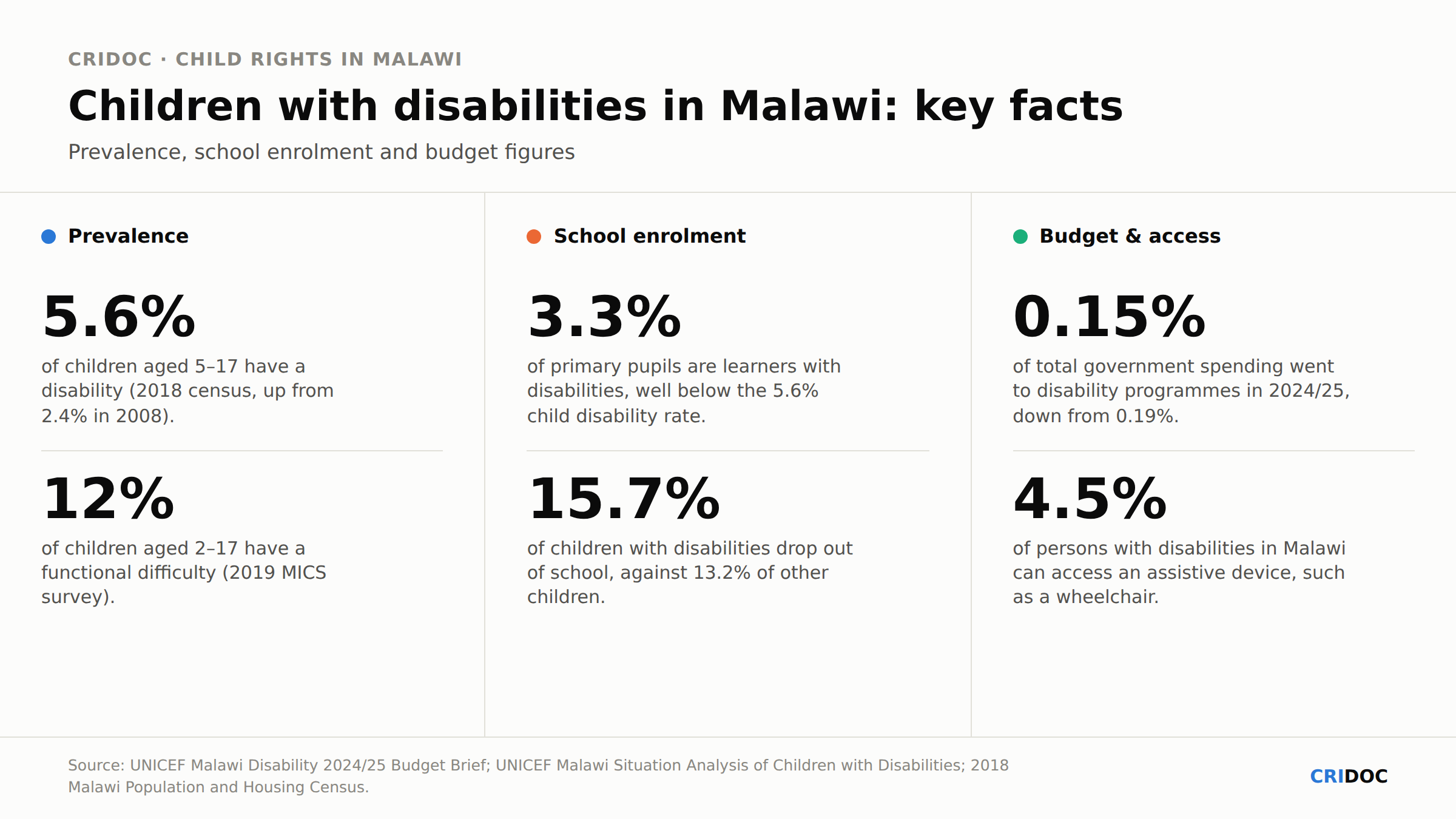
Government and UN data paint a consistent picture of children with disabilities in Malawi being left behind.
- Vision, mobility and hearing account for most childhood disabilities: visual impairment affects about 49% of children with a disability, mobility difficulties 27% and hearing loss 24%, per the 2018 census.
- Learners with disabilities make up only 3.3% of primary school enrolment and 2.2% of secondary enrolment, well below the 5.6% disability rate among school-age children, the 2024/25 UNICEF budget brief found. That gap points to thousands of children who never start school or go unrecorded.
- Children with disabilities drop out of school at a rate of 15.7%, against 13.2% for children without disabilities, according to UNICEF’s Situation Analysis of Children with Disabilities in Malawi.
- Nearly half of childhood disabilities, 48.7%, stem from preventable disease, the same UNICEF analysis found, pointing to a clear case for stronger early health care.
- Disability spending fell to just 0.15% of total government expenditure in 2024/25, down from 0.19% the year before, even though the overall disability budget rose in cash terms.
- Only 4.5% of persons with disabilities in Malawi have access to an assistive device such as a wheelchair, hearing aid or white cane, the 2024/25 budget brief found.
Where the gaps are for children with disabilities in Malawi
Three problems repeat across the evidence: these children are hard to find in the data, hard to keep in school, and hard to keep safe.
Schools that are not ready for them
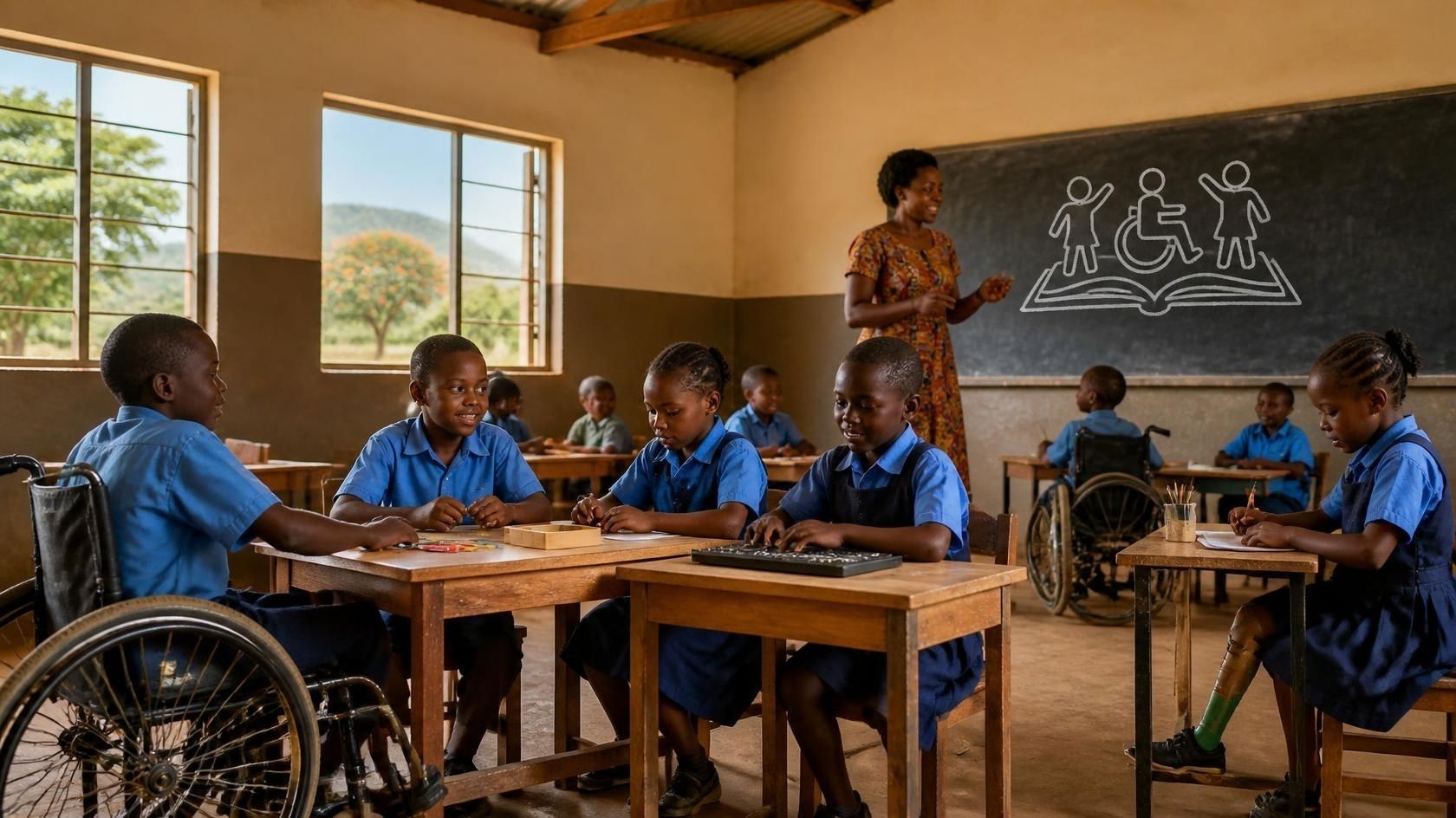
Special needs teacher training colleges, such as Machinga Teacher Training College and Montfort College, exist and receive government funding. Even so, a 2022 study in the African Journal of Disability found that children with disabilities in rural Malawi still face inaccessible buildings, too few trained teachers and long distances to the nearest inclusive school. Many families simply keep a child at home rather than fight these barriers daily.
Money that does not reach the ground
The Disability Trust Fund, created to help pay for disability programmes, received MK375 million between 2019/20 and 2022/23 but had, at that point, disbursed none of it, the UNICEF budget brief for that period found. By 2024/25, 80% of MACODA’s own budget went on staff costs, leaving only 20% for the programmes these children actually rely on. District offices, where most casework happens, received close to nothing.
Violence that goes unreported
Children with disabilities face far higher rates of violence than their peers. A study across Malawi and Uganda, summarised by the London School of Hygiene & Tropical Medicine, found that 84% of children with disabilities reported some form of violence at school in the past week alone. Girls with disabilities reported sexual violence by school staff at five times the rate of girls without disabilities. Many of these children cannot describe what happened to them, do not know where to seek help, or fear they will not be believed.
Children pushed out of family life
In August 2023, the UN Committee on the Rights of Persons with Disabilities questioned Malawi’s government directly about children with disabilities being placed in “alternative placements,” despite official claims that no institutionalisation takes place, according to a summary from the UN Office at Geneva. The Committee also raised a smaller but telling gap: girls with disabilities missing school because they cannot get menstrual hygiene materials suited to their needs. Committee members further found Malawi’s disability data collection fragmented, which government representatives admitted, making it harder to know exactly how many children with disabilities in Malawi are missing from school, health and protection services altogether.
Case studies: what is already working
Real programmes in Malawi show that these gaps can close when the right support reaches children.
Inclusive pre-schools open the first door
Since 2020, Sightsavers has worked with more than 40 community childcare centres in Malawi to welcome young children with disabilities alongside their peers. The programme trains caregivers, supplies adapted bikes and wheelchairs for transport, and grows food through community gardens to fund the centres. Shelista, a seven-year-old deaf girl, went from distressed and withdrawn to confident and settled after she joined. Her mother, Rose, said: “When she wakes up now, she’s sweeping the yard… she’s no longer crying.” Children who start school this early are far more likely to stay in education later on.
Chiefs and communities confront old beliefs about albinism
Children with albinism face some of the sharpest stigma in Malawi, rooted in harmful myths that link albinism to wealth or witchcraft. A June 2026 report by Human Rights Watch, based on interviews across nine districts, found that children with albinism still face bullying, poor eyesight support and high dropout rates, even as attacks have fallen from their peak. The report credits growing access to large-print exam materials and government’s 2025 National Disability Policy as real, if partial, progress.
A UN review holds government to account
Malawi’s own delegation defended its record before the Committee on the Rights of Persons with Disabilities in Geneva in August 2023, and pointed to concrete steps under way, including the construction of 257 schools and a commitment of 4% of the education ministry’s budget to special needs equipment. A government willing to answer hard questions, in public, about disabled children’s rights is itself a sign that advocacy is being heard.
Opportunities to close the gap
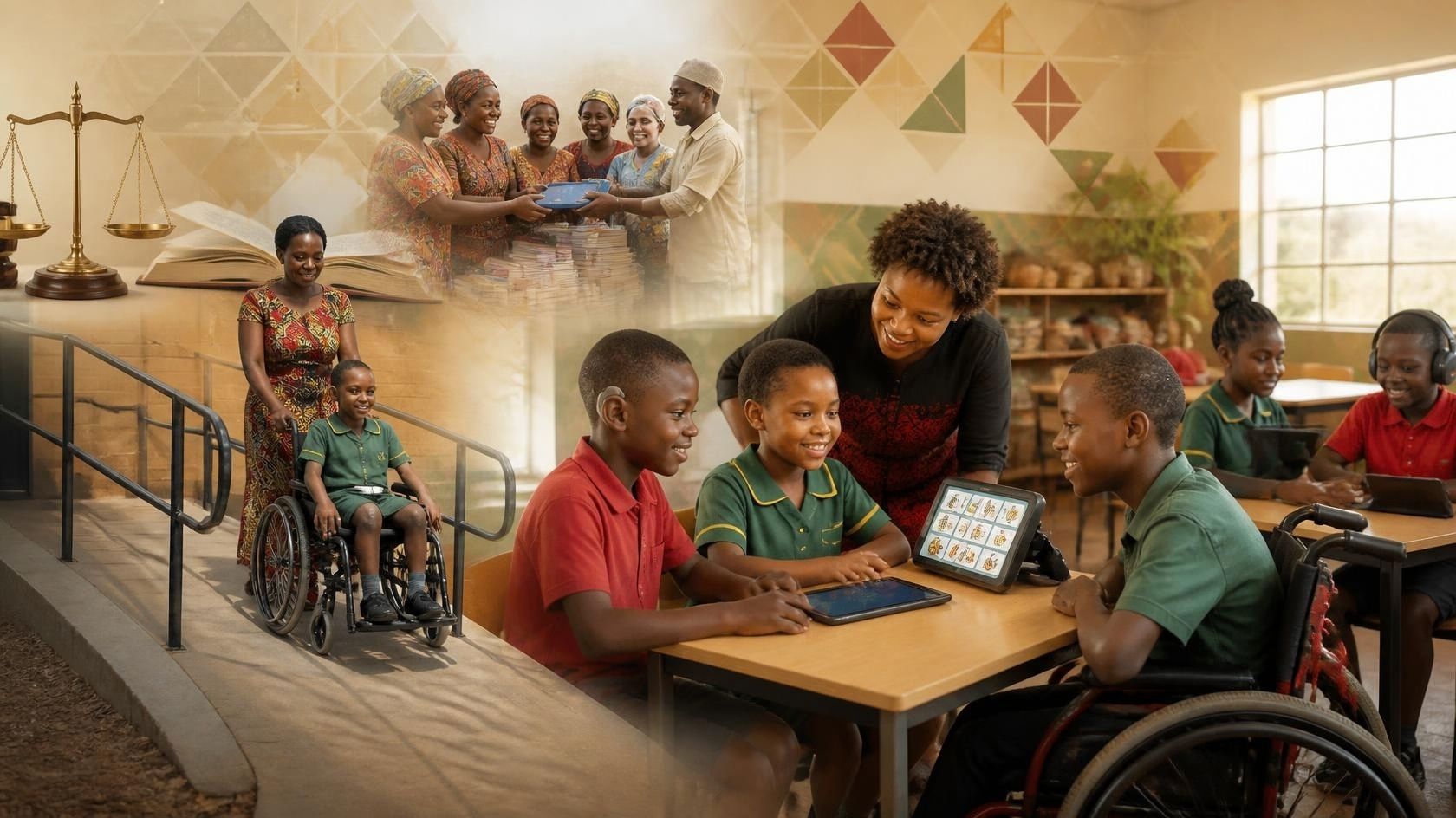
Malawi does not need to start from nothing. Several openings, some already in motion, could make a real difference for these children.
- Finish putting the Persons with Disabilities Act, 2024, and the National Disability Policy 2025 into practice, with clear regulations and funded district offices.
- Add explicit protections for children with disabilities to the Child Care, Protection and Justice Act, so abuse involving a child with a disability is easier to report, investigate and prosecute.
- Get the Disability Trust Fund disbursing money to schools and community programmes, not sitting unused.
- Build on Malawi’s own research into a national priority assistive products list, developed with global health partners, so wheelchairs, hearing aids and low-vision aids reach far more of the 95% of children with disabilities who currently go without.
- Scale up inclusive pre-school models like Sightsavers’ community centres, since early inclusion keeps children in school for longer.
- Protect and raise disability spending as a share of the national budget, reversing its recent fall from 0.19% to 0.15% of total expenditure.
- Fix Malawi’s fragmented disability data systems, as the UN Committee has urged, so children with disabilities are counted, not missed.
None of these steps need to wait for the others. Regulations, funding and data reform can move together.
How CRIDOC supports children with disabilities in Malawi
Good decisions need good information, and that is why CRIDOC exists.
Our Child Rights eLibrary holds laws, policy papers and research on child rights in Malawi, including material on disability rights, free for anyone to search and download. Researchers, teachers, parents and policymakers can search the collection, download what they need, and add their own documents to grow it further.
Through our School Outreach Programme, we help build school libraries and children’s clubs that welcome every child, including children with disabilities. A child who can read about their own rights is better placed to ask for help when those rights are not met.
How you can help
You do not need to be a specialist to make a difference for children with disabilities in Malawi.
- Share this article so more people understand the gaps and the law.
- Add research or reports on disability and child rights to the CRIDOC eLibrary.
- Report any child you believe is at risk of abuse or neglect to your nearest social welfare office, police station or chief.
- Support inclusive school libraries and clubs through CRIDOC’s school outreach work.
Visit our Support Us page to volunteer, donate or partner with us.
Conclusion
Malawi has written strong laws for children with disabilities, from the 2024 Persons with Disabilities Act to decades-old treaty commitments. What is missing is not ambition, but follow-through: funded schools, working trust funds, honest data and a child protection law that sees disability clearly. Programmes such as Sightsavers’ inclusive pre-schools, and a government willing to face tough questions at the United Nations, show that change is possible.
Closing the gap for children with disabilities in Malawi will take government, communities, donors and families working together. Every child, whatever their disability, has the right to a school, a doctor and a safe home. Malawi’s task now is to make that right real for all of them.
References
- UNICEF Malawi (2024). Disability 2024/25 Budget Brief: Investing in Disability. https://www.unicef.org/malawi/media/12081/file/UNICEF_MLW_Disability_Budget_Brief_2024-25_A4.pdf.pdf
- UNICEF Malawi (2022). Leaving No One Behind: Ensuring Children with Disabilities in Malawi Have Access to Services. Disability Budget Brief 2022/23. https://www.unicef.org/esa/media/11131/file/UNICEF-Malawi-Disability-Budget-Brief-2022-2023.pdf
- UNICEF Malawi (2020). A Situation Analysis of Children with Disabilities in Malawi. https://www.unicef.org/malawi/reports/situation-analysis-children-disabilities-malawi
- Government of Malawi (2024). Persons with Disabilities Act, 2024 (Act No. 4 of 2024). MACODA. https://macoda.mw/public/assets/uploads/publications/240812090242_Persons%20with%20Disabilities%20Act,%202024.pdf
- Nation Online (2023). Parliament Passes New Disabilities Law. https://mwnation.com/parliament-passes-new-disabilities-law/
- Malawi Broadcasting Corporation (2024). FEDOMA Happy with Disability Act Enactment. https://mbc.mw/fedoma-happy-with-disability-act-enactment/
- United Nations Office at Geneva (2023). Experts of the Committee on the Rights of Persons with Disabilities Acknowledge Malawi’s Efforts to Implement the Convention. https://www.ungeneva.org/en/news-media/meeting-summary/2023/08/experts-committee-rights-persons-disabilities-acknowledge
- Sightsavers (2021). Education, Not Discrimination: Malawi’s Inclusive Pre-Schools. https://www.sightsavers.org/stories/2021/09/malawi-inclusive-pre-schools/
- Human Rights Watch (2026). Malawi: People with Albinism Face Discrimination, Barriers to Work. https://www.hrw.org/news/2026/06/12/malawi-people-with-albinism-face-discrimination-barriers-to-work
- London School of Hygiene & Tropical Medicine (2016). Children with Disabilities Living in Malawi and Uganda Experience Higher Levels of Violence. https://www.lshtm.ac.uk/newsevents/news/2016/children_disabilities_malawi_uganda_violence.html
- Sightsavers USA (2024). Landmark Disability Rights Treaty Comes into Force Across Africa. https://www.sightsaversusa.org/news/2024/08/landmark-disability-rights-treaty-comes-into-force-across-africa/
- Banks, L. M. et al. (2022). ‘I Might Be Lucky and Go Back to School’: Factors Affecting Inclusion in Education for Children with Disabilities in Rural Malawi. African Journal of Disability. https://ajod.org/index.php/ajod/article/view/981/2056
- Federation of Disability Organisations in Malawi (FEDOMA). About Us. https://www.fedomamw.com/about-us-1

Leave a Reply