

But I must explain to you how all this mistaken idea of denouncing pleasure and praising pain was born and will give you a complete account of the system and expound the actual teachings of the great explore


The Child Protection and Justice Act shapes how Malawi cares for and protects every child. This guide explains what it says, where it falls short, and what stakeholders want changed.
At CRIDOC, we help people find and use child rights information in Malawi. This guide draws on the Act itself, court judgments, government data and reports from rights groups working across the country.
Year Passed
Parliament passed the Act on 29 July 2010, in force from October 2011.
Age of a Child
The Act defines a child as under 16, not 18 as the UN Convention requires.
Budget Cut
Malawi's child protection budget fell by this much in 2024/25, UNICEF found.
Years in Prison
The maximum term for forcing a child into marriage or trading a child as security.
The Child Protection and Justice Act also creates Child Justice Courts, child panels and a Child Case Review Board to run a separate justice system for children.
Before this law, Malawi's child protection rules sat scattered across old colonial-era statutes. The Child Protection and Justice Act pulled them into one law and added a modern child justice system.
Its long title states the goal plainly: to consolidate the law on children by providing for child care, child protection, child justice and a child's social development. It sits alongside the Constitution, the Marriage Act and the Employment Act.
Parliament passes the Child Protection and Justice Act to protect children and create child justice courts.
Malawi tells the African Union it will raise the legal age of a child to 18.
A judge orders children moved out of adult prisons at Bvumbwe and Kachere.
The Malawi Human Rights Commission urges Parliament to review the Act's gaps.
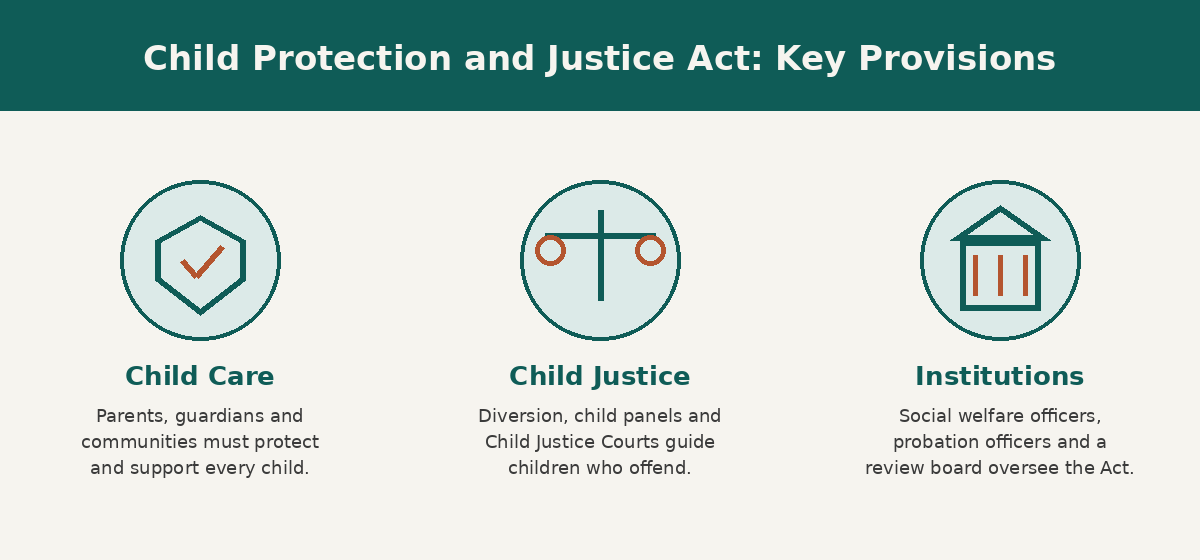
The Act runs to more than 160 sections. Most fall under two main parts: child care and protection, and child justice. A third part covers working out a child's age.
The Child Protection and Justice Act defines a child as anyone below 16 years old. This single definition sits at the centre of most debates about the law today.
The UN Convention on the Rights of the Child, which Malawi ratified in 1991, defines a child as anyone under 18. So does the African Charter on the Rights and Welfare of the Child. Human Rights Watch has documented how officials, including magistrates and police, often treat 16 and 17-year-olds as adults because of this gap.
In 2016, Malawi told the African Union it would raise the age of a child to 18. Nearly a decade on, the Act and the Constitution still set the line at 16, even though the Marriage Act now sets 18 as the legal age to marry.
This is not a small technical point. It decides who gets a probation officer, who goes to a safety home instead of an adult cell, and who counts as a child abuse survivor rather than an adult victim of crime.
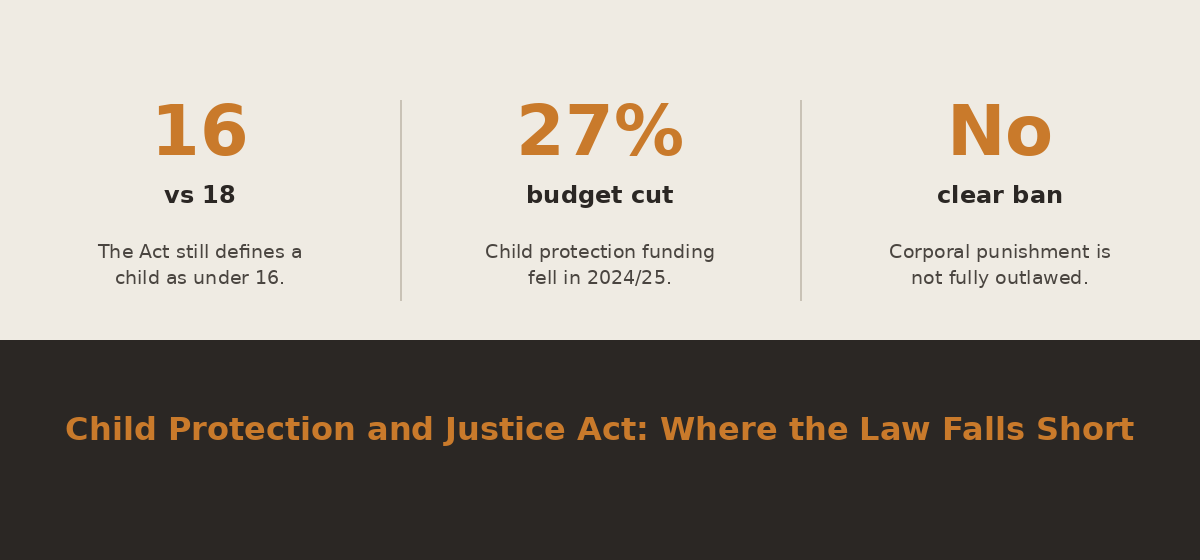
Strong wording on paper does not always mean strong protection in practice.
Court records and reports show both the promise and the strain of the child justice system the Act created.
In 2018, Judge Sylvester Kalembera ruled that holding children at Bvumbwe and Kachere prisons was "improper and illegal," and ordered their transfer within 30 days.
Source: AfricanLII, 2019Female chiefs in Kasungu and Salima banned harmful ceremonies and used their authority to annul customary child marriages, in one case 330 at once.
Source: UNFPA Malawi, 2020Chikomola v Matola, a Child Justice Review case from October 2022, shows the High Court still reviews Child Justice Court decisions made under the Act.
Source: MalawiLII, 2022The people who use this law every day broadly agree it was a major step forward, and just as broadly agree it now needs updating.
Calls on Malawi to finish the job it promised in 2016, and raise the legal age of a child to 18 across every statute.
Commissioner Boniface Massa says the Act must be reviewed so it "clearly protects children and addresses gaps in the current legal framework."
Recommends protecting child protection spending from further cuts and running a new national survey on violence against children.
Argues Malawi's laws on age, marriage and consent need to line up, or officers will keep making different calls in similar cases.
Taken together, these views point to a clear reform agenda.
Our Child Rights eLibrary holds laws, policy papers and research on child rights in Malawi, free for anyone to search and download, including the full text of the Child Protection and Justice Act. Through our School Outreach Programme, we help children learn what the law says about their own rights.
Government, families, schools and partners all have a part to play in making the Child Protection and Justice Act work for every child.